Choosing the right solar inverter is an important part of designing an efficient and reliable solar power system. Different inverter configurations offer different advantages depending on the installation type, available roof space, shading conditions, energy requirements and budget.
Among the most commonly discussed options are string inverters, micro inverters and grid-tied inverters. Although these terms are often used interchangeably, they describe different aspects of solar inverter technology. Understanding how they work and how they differ can help homeowners, installers and businesses make informed decisions.
What is a grid-tied inverter?
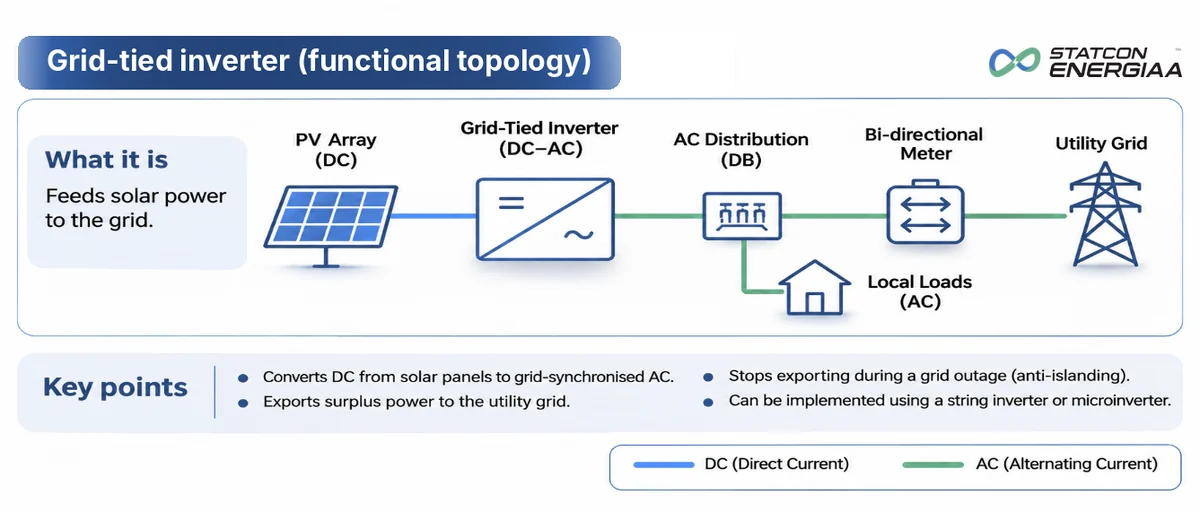
A grid-tied inverter is designed to convert the DC (direct current) electricity generated by solar panels into AC (alternating current) electricity and synchronise it with the utility grid’s voltage and frequency.
The converted electricity can be used to power electrical loads, while surplus energy may be exported to the grid, depending on the applicable regulations and system configuration.
Key features of a grid-tied inverter
- Converts DC electricity generated by solar panels into AC electricity.
- Synchronises with the utility grid’s voltage and frequency.
- Enables solar power generation and grid energy export.
- Incorporates anti-islanding protection to disconnect during a grid outage.
- Conventional grid-tied systems generally operate without batteries.
- Can be designed using string inverter or micro inverter architecture.
What is a string inverter?
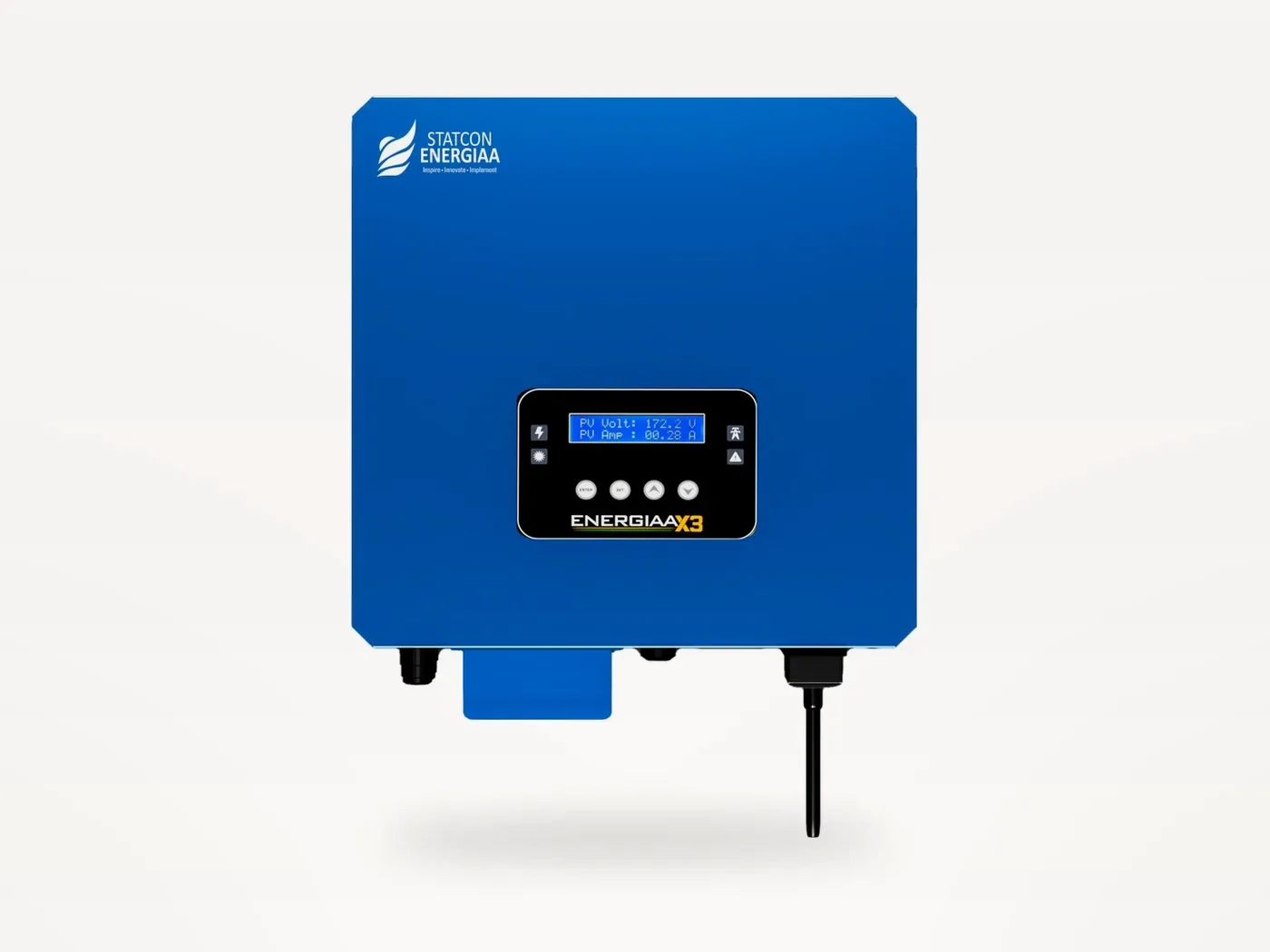
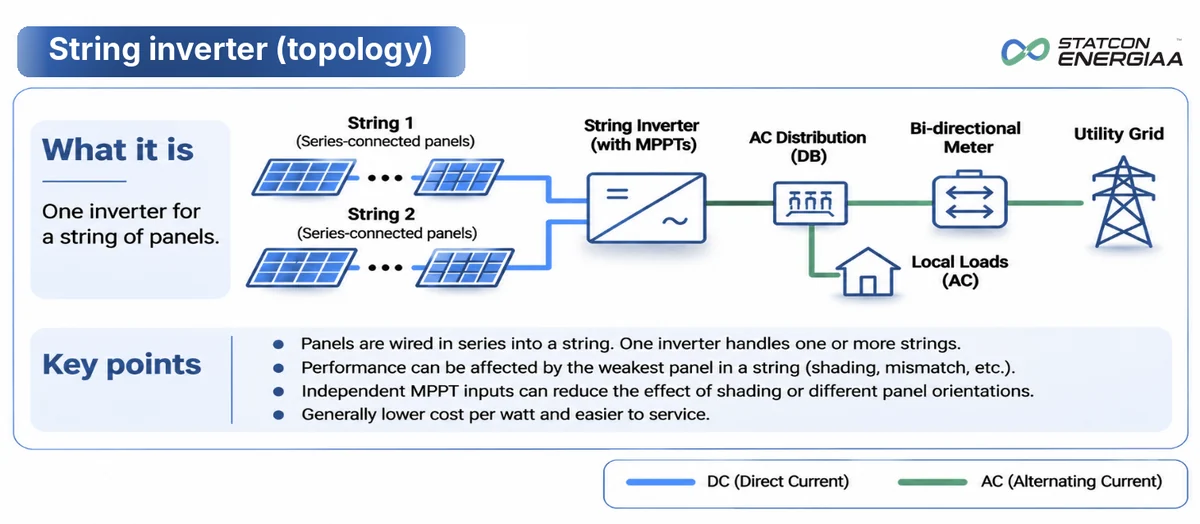
A string inverter is a solar inverter in which multiple solar panels are connected in series to form a string. The inverter converts the DC electricity generated by one or more strings into AC electricity.
String inverters are widely used in residential, commercial and industrial solar installations, particularly where panels receive relatively uniform sunlight.
How does a string inverter work?
Solar panels are connected in series, forming a string. The DC output from the string is routed to a central inverter, which converts it into AC electricity for consumption or grid export.
Key features of string inverters
- Multiple solar panels are connected in series to form a string.
- One inverter handles one or more strings of solar panels.
- Performance can be affected by shading, mismatch and variations between modules within a string.
- Independent MPPT inputs can help manage strings with different orientations or operating conditions.
- Centralised installation makes maintenance and servicing relatively convenient.
Where are string inverters best suited?
String inverters are particularly suitable for:
- Large, open and relatively unshaded rooftops.
- Commercial and industrial (C&I) solar installations.
- Ground-mounted solar power plants.
- Installations where cost-effectiveness and centralised maintenance are priorities.
What is a micro inverter?
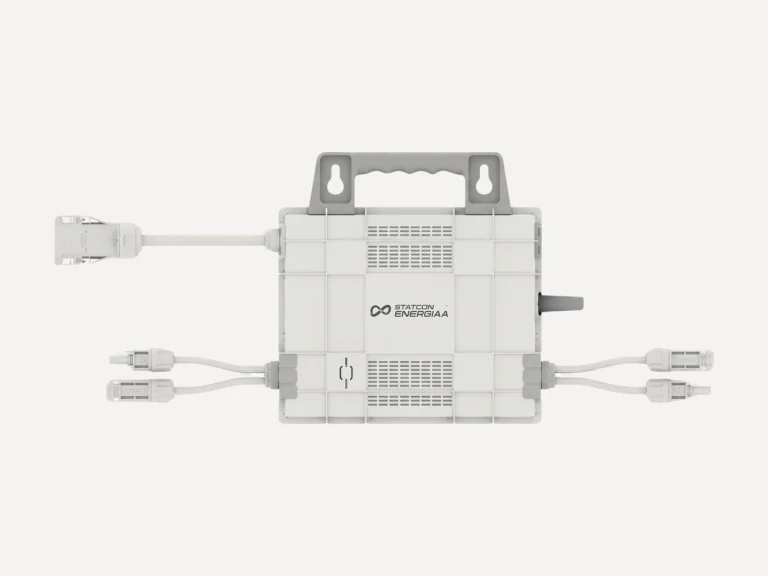
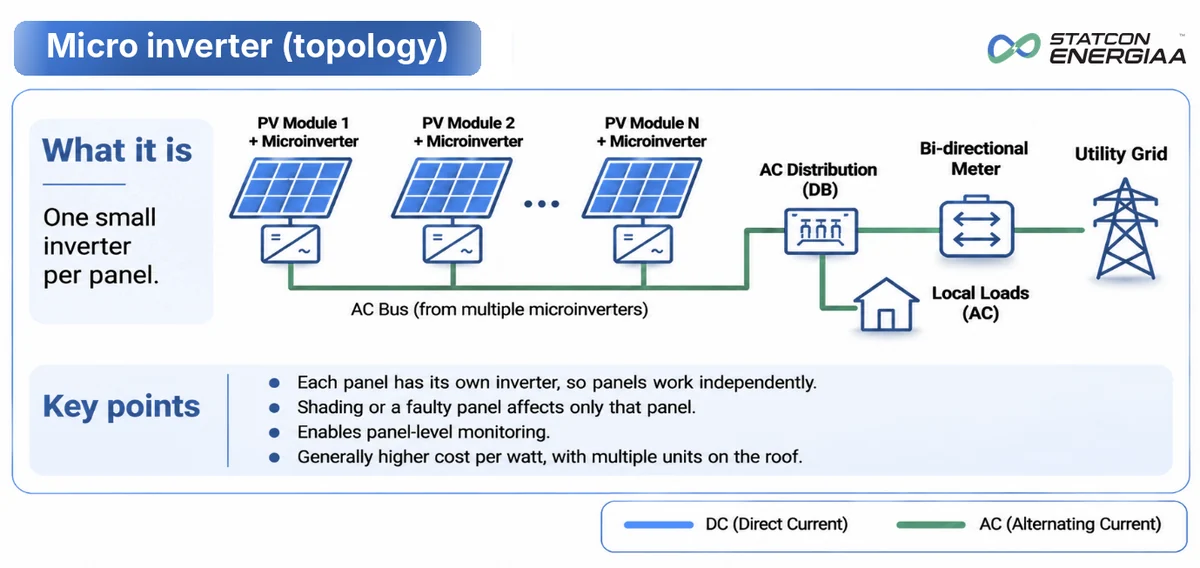
A micro inverter is a compact inverter installed at the individual solar panel level. Instead of routing DC electricity from multiple panels to a central inverter, each module typically converts its DC output into AC electricity independently.
This architecture allows individual panels to operate with greater independence from other modules in the system.
How does a micro inverter work?
Each solar panel is connected to its own micro inverter. The micro inverters convert DC electricity into AC electricity, which is combined through AC cabling and supplied to the building’s electrical system or the grid.
Key features of micro inverters
- Typically, one micro inverter is installed per solar panel.
- Each panel operates independently of the other panels.
- Shading or performance variations on one panel have a more localised impact.
- Enables panel-level monitoring and performance visibility.
- DC wiring is generally limited to the individual module level, with AC cabling running across the installation.
- Units are installed behind or near the solar panels, which can make rooftop servicing more complex.
Where are micro inverters best suited?
Micro inverters are particularly suitable for:
- Roofs with multiple orientations or inclinations.
- Installations where panel-level monitoring is desirable.
- Smaller solar systems where individual module optimisation is beneficial.
String and micro inverters side by side
| String inverter | Micro inverter | |
|---|---|---|
| Where conversion happens | Centrally, for one or more strings | At each panel, or at a small group of panels |
| Effect of shading on one panel | Can affect the output of the whole string | More localised to the affected panel |
| Monitoring granularity | Typically string level | Panel level |
| Initial cost per watt | Generally lower | Generally higher |
| Maintenance access | Centralised and relatively convenient | Units sit behind or near the panels, so rooftop access is needed |
| Wiring | DC runs from the array to the inverter | DC stays at module level, AC runs across the installation |
| Typically suited to | Large, open, unshaded roofs; C&I and ground-mounted plants | Multiple roof orientations, partial shading, smaller systems |
Multi-module micro inverter configuration
Nowadays, micro inverters are available in configurations that support the connection of 2 or even 4 PV modules to a single inverter unit. The connection topology for these configurations is illustrated below.
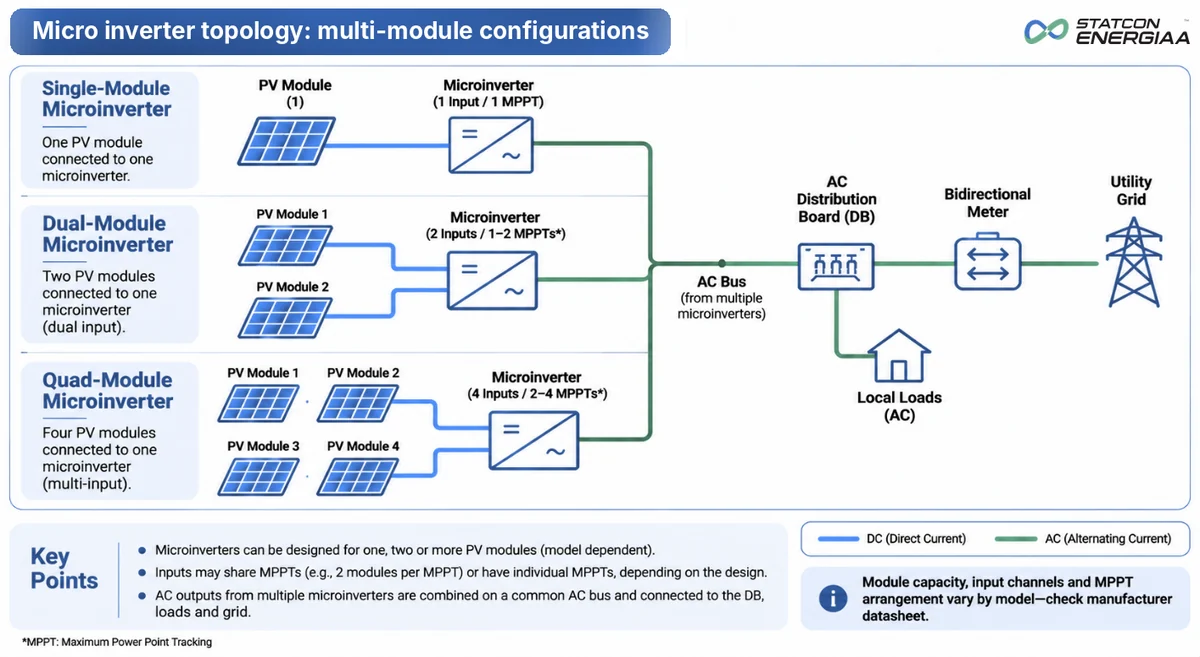
However, the fundamental working principle remains the same as explained above. Each micro inverter converts the DC power generated by the connected PV modules into AC power at the module level. The generated AC outputs are then combined and connected to the AC distribution system for supplying local loads and exporting surplus power to the utility grid.
Note: the number of PV modules supported, input channels and MPPT configuration vary depending on the micro inverter model and manufacturer.
Frequently asked questions
Is a string inverter the same as a grid-tied inverter?
No. A string inverter describes the architecture in which multiple solar panels are connected in strings to a central inverter. A grid-tied inverter describes an inverter that operates in synchronisation with the utility grid. A string inverter can be grid-tied.
Can a grid-tied inverter work during a power cut?
A conventional grid-following inverter automatically disconnects during a grid outage due to anti-islanding protection. Backup power requires a specifically designed backup-capable system, typically with compatible battery storage.
Which inverter is better for a partially shaded rooftop?
Micro inverters may be advantageous for partially shaded rooftops because each panel operates independently. However, the actual performance benefit depends on the extent and pattern of shading, system design and equipment specifications.
Are micro inverters more expensive than string inverters?
Micro inverter systems generally have a higher initial cost per watt. However, the overall economics depend on installation conditions, system size, shading, monitoring requirements and equipment costs.
Can a string inverter work with a battery?
Some string inverter systems are designed to support battery integration, while others are not. Battery compatibility depends on whether the inverter is hybrid or specifically designed for energy storage integration.
What is the difference between a hybrid inverter and a grid-tied inverter?
A conventional grid-tied inverter primarily converts solar DC electricity into AC electricity for grid-connected operation. A hybrid inverter is designed to integrate solar generation with battery storage and may offer backup functionality, subject to its specifications and system configuration.
Conclusion
String inverters, micro inverters and grid-tied inverters serve different purposes within solar energy systems.
String inverters offer a practical and cost-effective solution for larger, relatively unshaded installations. Micro inverters provide module-level conversion and monitoring, making them suitable for rooftops with shading or multiple orientations. Grid-tied, meanwhile, describes the inverter’s operating relationship with the utility grid rather than its physical architecture.
Understanding these distinctions helps ensure the right inverter is selected for the application, delivering reliable operation, efficient energy utilisation and long-term value.
Statcon Energiaa builds both architectures in India, from on-grid string inverters to the ENERGIAA-M micro inverter series, so our engineers can size either against the same site.
Before finalising an inverter selection: power ratings, MPPT configurations, supported panel quantities, warranty terms, battery compatibility and backup features vary by manufacturer and model. Always verify these details against the relevant product datasheet.
Ask an engineer
Need a quote?
Send the voltage, current and site conditions. An application engineer will reply with a configuration.